
Fall begins at an exact moment. So what actually happens?


Fall doesn’t slowly arrive.
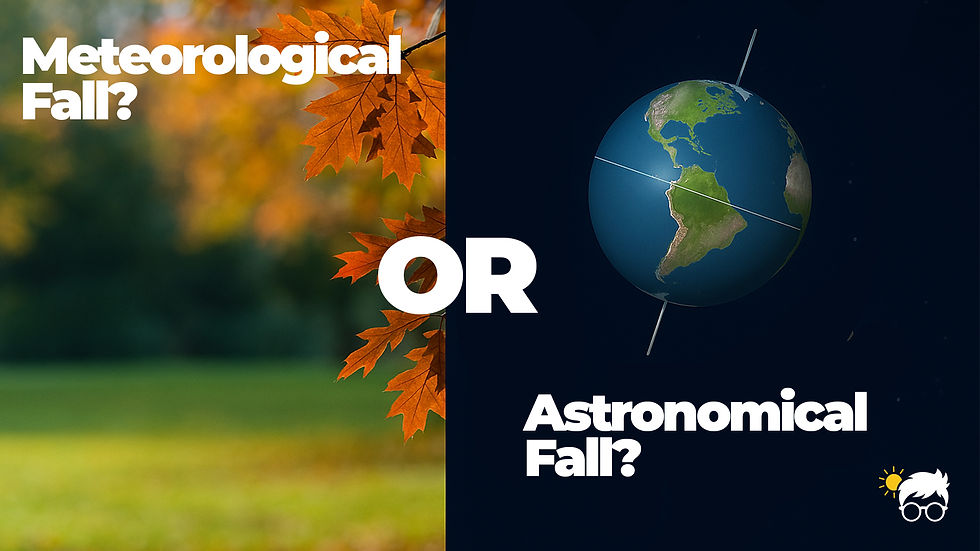
Astronomically, it begins at one exact instant. In 2026, that happens September 22 at 8:05 p.m. EDT, when summer officially ends and fall begins across the Northern Hemisphere.
You won’t feel it happen. The temperature won’t suddenly drop. No leaf gets an official memo. Pumpkin spice will not begin falling from the sky.
But something very real happens between Earth and the Sun.
And once you understand what it is, the first day of fall gets a whole lot more interesting.
What happens at the autumnal equinox?
The autumnal equinox happens at the precise moment the center of the Sun crosses an imaginary line in our sky called the celestial equator, heading south.
That sounds considerably more complicated than it actually is.
Imagine taking Earth’s equator and extending it outward into space like an enormous invisible hula hoop. That’s basically the celestial equator.
As Earth travels around the Sun, the Sun appears to move north and south of that imaginary line during the year. At the September equinox, it crosses from the northern side to the southern side.
Nothing clicks. Nothing flashes. Earth doesn’t make the Windows shutdown sound.
But that crossing is the moment astronomical fall begins.
Which brings up a pretty reasonable question.
Why should crossing an imaginary line change an entire season?
Why does crossing that line mean summer is over?
Because our seasons aren’t really about temperature.
They’re about sunlight.
Earth doesn’t sit perfectly upright as it travels around the Sun. Its axis is tilted about 23.5 degrees. As our planet makes its yearly trip, that tilt changes which hemisphere gets longer days and more direct sunlight.
Around the September equinox, Earth’s axis is tilted neither toward nor away from the Sun. After the equinox, the Northern Hemisphere continues toward the part of Earth’s orbit where it is tilted away from the Sun.
The Sun appears lower in our sky. Its rays hit us less directly. Our days keep getting shorter.
Fall isn’t declared because somebody in Vermont spotted the first orange leaf.
It’s written into the geometry of the planet.
But if you’ve ever learned what the word equinox means, you may have spotted a problem.
Doesn’t equinox mean equal day and night?
Yep.
Except…
day and night aren’t actually exactly equal on the equinox.
The word equinox comes from Latin words meaning roughly equal night, and the geometry gets us very close to 12 hours of day and 12 hours of night.
But Mother Nature slipped some fine print into the deal.
For starters, sunrise and sunset aren’t measured using the center of the Sun. Sunrise occurs when the Sun’s upper edge first appears above the horizon, and sunset isn’t finished until that upper edge disappears.
That adds a little daylight.
Then Earth’s atmosphere cheats too.

How can the atmosphere make the day longer?
It bends sunlight.
The technical word is refraction, but you’ve seen the same basic trick when a straw appears bent inside a glass of water. Light changes direction when it travels through different materials.
Our atmosphere bends sunlight near the horizon just enough that we can see the Sun for a short time even when it is geometrically below the horizon.
That makes sunrise appear slightly earlier and sunset slightly later.
So despite the name, most places don’t get precisely 12 hours of daylight and 12 hours of darkness on the equinox. The date when they’re closest to equal depends on where you live.
Apparently even the equinox needs an asterisk.
And now we get to the part your thermometer may find particularly amusing.
If fall has begun, why can it still feel like summer?
Because the atmosphere doesn’t care what your calendar says.
The land and especially the oceans have spent months absorbing summer energy. All that stored heat doesn’t vanish the instant Earth reaches a particular point in its orbit.
Think of turning off an oven. The heating element may be off, but you probably don’t want to stick your hand inside five seconds later.
Earth works on a much larger scale.
The amount and angle of sunlight are changing, but the atmosphere and oceans need time to respond. That’s why September can still produce scorching afternoons even after astronomical fall begins.
It’s also why meteorologists have their own version of fall.
Meteorological fall begins September 1 and includes September, October and November. Those three months generally line up better with the temperatures we actually experience, and using complete months makes climate statistics much easier to compare from year to year.
So meteorologists started fall weeks ago.
Astronomers waited for the geometry.
Two falls. Same planet.
Apparently one wasn’t complicated enough.
What actually changes after the autumnal equinox?
Don’t watch the thermometer.
Watch the Sun.
Over the coming weeks, it will rise later, set earlier and follow a lower path across the sky. Your midday shadows will grow longer. The point where the Sun sets will continue creeping southward along the horizon.
And the Northern Hemisphere will continue losing daylight until the winter solstice in December.
That’s the part of the equinox you can actually watch happen.
The autumnal equinox itself lasts only an instant. Most years, you’ll be doing something completely ordinary when it happens. Eating dinner. Driving home. Watching television. Maybe wondering why it’s still way too hot outside to possibly be fall.
But somewhere above all of that ordinary life, the geometry becomes perfect.
The Sun crosses an invisible line in our sky. One astronomical season becomes another. And Earth quietly continues along an orbit it has traveled billions of times before.
No fireworks.
No sudden cold front.
No leaf required.
Just an entire planet quietly turning the page.
And once you know what’s happening, the first day of fall doesn’t seem quite so ordinary anymore.
Talk Weather To Me!
Love weather stories that make you say, “I never knew that!”?
Join the free Talk Weather To Me newsletter and get one fascinating weather or science story delivered to your inbox every morning in about two minutes. No hype. Just one great curiosity to start your day.
Subscribe free at WeatherNerdy.com/daily.


Comments