
What Causes Summer Heat Waves?

Updated: Jul 27
What Causes Summer Heat Waves?
If the Sun doesn’t suddenly get stronger during the summer, what causes summer heat waves? Why do temperatures sometimes soar into the upper 90s or even above 100 degrees?
The answer may surprise you.
It usually isn’t because the Sun changed at all.
It’s because the atmosphere changed.
So what happens in the atmosphere that suddenly turns an ordinary summer week into a dangerous heat wave?
Doesn’t the Sun Stay About the Same All Summer?
Mostly, yes.
By late June and July, the angle of the Sun changes only gradually. The days also shorten very slowly after the summer solstice.
So the amount of solar energy reaching the ground doesn’t suddenly jump from one week to the next.
That means something else has to explain why temperatures can swing 10 or even 20 degrees.
What is it?
What Actually Creates a Heat Wave?
The biggest culprit is usually a large area of high pressure.
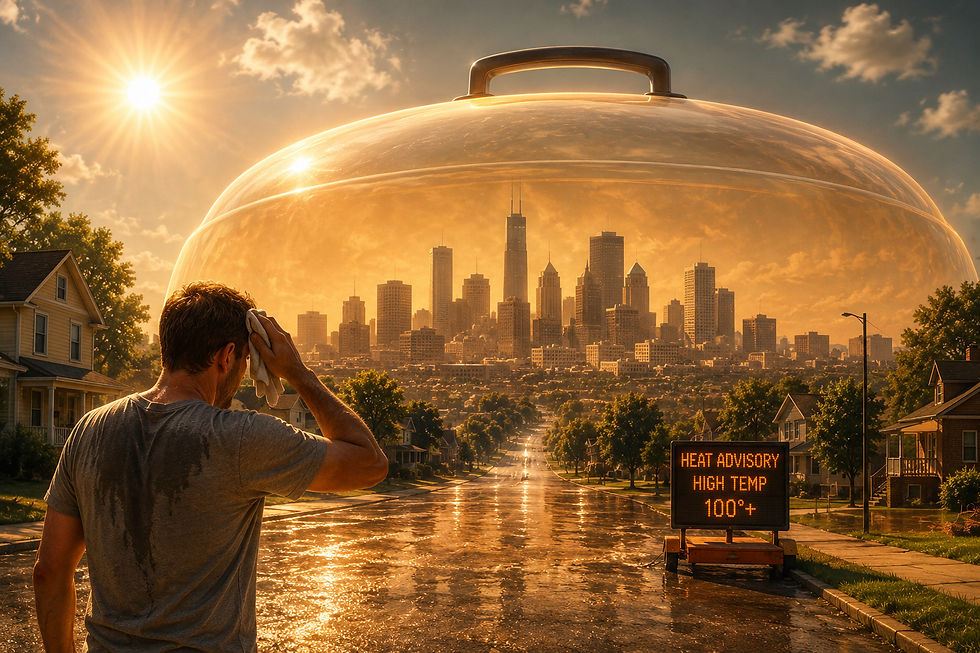
Meteorologists often call it an upper-level ridge or, when it’s especially strong, a heat dome.
Air inside this high-pressure system slowly sinks toward the ground.
That might not sound important, but sinking air naturally compresses.
And when air compresses, it warms.
It’s the same physics that makes a bicycle pump get warm when you push down on it.
Now the atmosphere isn’t just allowing sunshine to heat the ground.
It’s adding heat of its own.

Why Does It Keep Getting Hotter Every Day?
A heat wave doesn’t just bring hot air.
It also keeps the atmosphere from cooling itself.
High pressure usually means fewer clouds. That allows sunshine to pour in hour after hour.
At the same time, lighter winds and a lack of widespread rain mean there’s very little to interrupt the heating.
Each afternoon starts from an already warm morning, allowing temperatures to climb even higher.
Why Does the Midwest See These Big Temperature Swings?
The Midwest is especially vulnerable because it sits in the middle of a huge continent.
When a strong ridge parks over the central United States, there’s no ocean nearby to help moderate temperatures.
Instead, the same hot air can sit over cities for days while sunshine continues to build the heat.
Eventually, a cold front arrives, the ridge breaks down, and cooler air finally moves in.
Think of It Like an Oven
Imagine your oven set to 350 degrees.
The setting doesn’t change.
But if you keep opening the door, heat escapes.
Close the door tightly, and the oven quickly becomes much hotter inside.
Summer works in a similar way.
The Sun is the oven.
A heat wave is the atmosphere closing the oven door.
The Bottom Line
The next time temperatures suddenly spike, remember this:
The Sun probably didn’t get stronger. Instead, the atmosphere became much better at trapping and building heat.
That’s why one week can feel like a typical summer…
…and the next can feel like an oven.
Enjoy weather mysteries like this? Subscribe to Talk Weather To Me and discover the fascinating science behind the forecast every week.


Comments