
September weather: 5 things that might surprise you
- Ric Kearbey

- 9 hours ago
- 5 min read

September weather has a bit of an identity crisis.
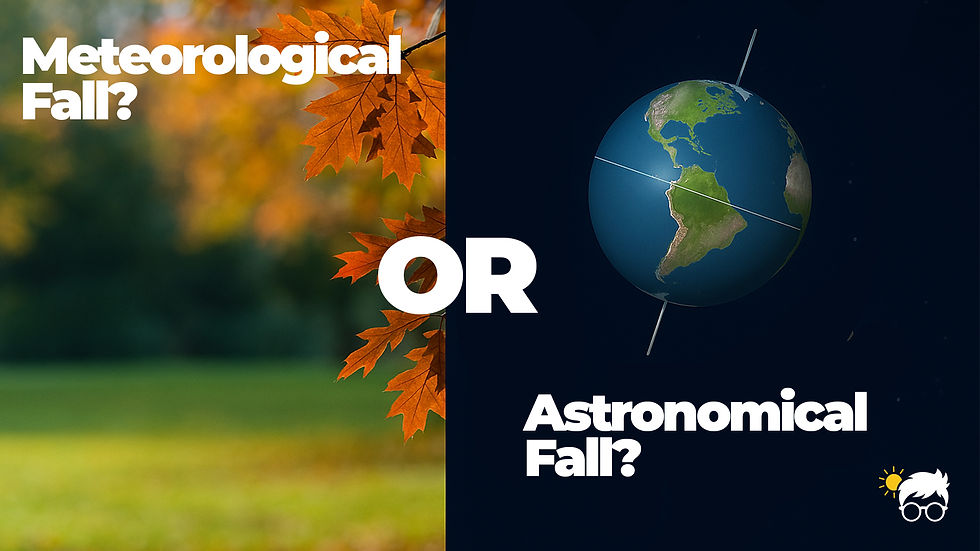
Meteorological fall has arrived, but September can still produce the hottest day of the entire year. Meanwhile, daylight starts disappearing surprisingly fast, big shots of cooler air become possible and, in some parts of the country, it can already snow.
Welcome to September.
Apparently, it has commitment issues.
1. September steals an astonishing amount of daylight
You already know the days are getting shorter. What may surprise you is how quickly it happens during September.
As the Northern Hemisphere approaches the autumnal equinox, the geometry of Earth’s tilted axis and its journey around the Sun causes daylight to change particularly quickly. The farther north you live, the more dramatic the September daylight plunge becomes.
Northern cities can lose well over an hour of daylight during the month, while the change is considerably smaller in places such as South Florida. And no, Daylight Saving Time isn’t responsible. We’re talking about the actual amount of time the Sun spends above the horizon.
Chicago provides a great example. On September 1 this year, Chicago gets about 13 hours and 7 minutes of daylight. By September 30, that’s down to about 11 hours and 47 minutes.
That’s a loss of roughly 80 minutes of daylight in one month.
You’ll probably notice it most in the evening. In Chicago, the Sun sets around 7:23 p.m. on September 1. By September 30, sunset is around 6:33 p.m.
That’s 50 minutes earlier in just one month. The rest of the daylight loss happens in the morning as sunrise gets later, too.
And just as you’re starting to think summer is obviously packing its bags, September pulls its next trick.
2. Your hottest day of the entire year could still happen in September
This one feels wrong.
We’re already in meteorological fall. Surely the hottest day of the year is behind us.
Not necessarily.
Chicago provides a fantastic example. On September 23, 2017, the temperature reached 95 degrees during an extraordinary stretch of late-season heat. That tied the hottest temperature Chicago experienced during the entire year and was the latest in the calendar year Chicago had ever experienced its annual hottest temperature.
Illinois did it again just last year. In Springfield, the hottest temperature of all of 2025 didn’t happen in June, July or August. It was 98 degrees on September 14.
And this isn’t just an Illinois thing.
Orlando: The city’s all-time record high, regardless of month, is 103 degrees on September 8, 1921.
New York City: On September 2, 1953, the temperature reached 102 degrees. That one is particularly fun for us because this story publishes September 2, exactly 73 years later.
Minneapolis: September has even produced a 104-degree day, on September 10, 1931. As recently as September 4, 2023, Minneapolis reached 98 degrees.
So September may be meteorological fall, but summer doesn’t necessarily surrender the thermostat at midnight on August 31.
Sometimes it saves one of its hottest days for the encore.
And if you’re tempted to call that scorching September comeback an Indian summer, hold on.
3. That September heat wave probably isn’t an “Indian summer”
People use Indian summer to describe almost any warm spell that shows up after Labor Day.
Traditionally, though, that’s not what the phrase means.
An Indian summer generally describes a stretch of unusually warm, quiet fall weather that arrives after a significant spell of cool weather, often after the season’s first frost. In other words, summer has to appear to leave before it can make the comeback that gives the expression its meaning.
There isn’t an official temperature that magically turns a warm afternoon into an Indian summer, and definitions have varied over the long history of the phrase. But a 95-degree afternoon during the first week of September when summer never really left?
That’s probably just September being September.
And yes, there’s much more to this little weather expression, including where it came from and whether we’ve all been using it wrong.
We’ll save that rabbit hole for another day.
Because September doesn’t merely bring warm spells. Sometimes it changes its mind with astonishing speed.
4. September can take you from 100° to freezing in a few days
Denver demonstrated this beautifully in September 2020.
On September 5, the city reached 101 degrees, its hottest September temperature on record and the latest date on the calendar Denver had ever reached 100 degrees.
Two days later, September 7 still reached 93 degrees.
Then a powerful push of cold air came charging through. Temperatures plunged into the 30s, with readings around the region falling below freezing.
Think about that. You can go from triple-digit heat to freezing temperatures in a matter of days.
That’s what makes September such an extraordinary transition month. Summer heat hasn’t disappeared, but longer nights and the changing atmospheric pattern increasingly open the door for much colder air to head south.
Mother Nature didn’t just stand in front of the closet trying to decide what to wear.
She grabbed the swimsuit and the parka.
And occasionally, the parka isn’t enough.
5. Yes, it can already snow
While much of the country is still mowing lawns, running air conditioners and squeezing in the last trips to the swimming pool, September can already bring snow to parts of the United States.
It’s most likely in Alaska, the higher elevations of the West and some of the colder northern reaches of the Lower 48. September snow is unusual for most populated parts of the country, but early-season snowstorms absolutely happen.
Remember Denver’s 101-degree afternoon from #4?
Three days later, Denver officially measured an inch of snow.
The September 8 snowfall tied for the city’s second-earliest measurable snowfall on record. Even more remarkable, the 93-degree high the previous day was the warmest temperature Denver had ever recorded on the day before measurable snow.
101 degrees to measurable snow in three days. Same September. Same city.
If September had a closet, apparently it wouldn’t bother organizing it.
So what makes September weather so weird?
September weather is so changeable because summer’s stored heat is still hanging around while the Northern Hemisphere is rapidly losing daylight and beginning its transition toward winter.
Those two seasons overlap rather than politely taking turns.
That’s September’s trick. It isn’t really summer anymore, but it isn’t completely fall either. The amount of sunlight is changing rapidly, cooler air is gaining opportunities to move south, and yet the atmosphere can still reach back into August’s closet and pull out a 95-degree afternoon.
So don’t expect September to pick a season and stick with it.
Watch the sunset creep earlier. Enjoy that first suspiciously cool morning. And maybe don’t pack away either the shorts or the sweatshirt just yet.
September isn’t the month summer ends. It’s the month summer and fall start arguing over the thermostat.
Talk Weather To Me!
Love weather stories that make you say, “I never knew that!”?
Join the free Talk Weather To Me newsletter and get one fascinating weather or science story delivered to your inbox every morning in about two minutes. No hype. Just one great curiosity to start your day.
Subscribe free at WeatherNerdy.com/daily.


Comments